Friday, November 3, 2017

Paul Newman Behind The Camera : Rachel, Rachel (1968)


"I'm in the exact middle of my life, this is my last ascending summer, everything else from now on is just rolling downhill into my grave" - Rachel Cameron

Paul Newman's work as a director is nowhere near as famous as his work as an actor. In fact, it's almost completely forgotten despite his debut film earning four Oscar nominations and winning two Golden Globes. One for Newman's direction and one for Joanne Woodward's outstanding central performance. Which in my opinion ranks higher than her much more appreciated and awarded turn in Nunnally Johnson's The Three Faces of Eve (1957). Throughout her career, Woodward was drawn to stories of complex women in difficult situations. She explored this theme further in Newman's The Effect of Gamma-Rays on Man-In-The-Moon Marigolds (1972).

Adapted by Rebel Without A Cause screenwriter Stewart Stern from the novel A Jest of God by Margaret Lawrence, Rachel, Rachel (1968) paints a desperate portrait of a complicated woman at a crossroads. A subtle social commentary that deals with issues such as unwed pregnancy, abortion and homosexuality. 

Rachel Cameron (Joanne Woodward) a 35-year-old unmarried school teacher from a small town in Connecticut, lives with her mother (Kate Harrington) above the funeral parlor that belonged to her late father. Rachel lives with a sense of detachment, an outsider both fascinated and frightened by the world around her. Childlike impulses and vivid fantasies illustrate her state of prolonged adolescence, a virgin whose life is still governed by the school calendar and the demands of a manipulative and overbearing mother.


Her best friend is fellow teacher Calla Mackie (Estelle Parsons) who is also unmarried but for an altogether different reason. Calla also lives on society's fringes as a closeted lesbian and her feelings for Rachel go beyond friendship. Which she discovers after a hallucinatory tabernacle meeting when Calla forcibly kisses Rachel on the mouth. Rachel's childish impulses take over and she runs away from a situation she has no idea how to deal with. 

One can imagine the quiet despair and resignation Calla feels as a lesbian in small town America. We spend the entire film focused on Rachel's situation and might not notice that Calla is caught in a desperate and lonely existence herself. The suffocating nature of a conformist society is most unkind to those who have committed no crime except being born chemically different. And the fault lines beginning to show during the late 1960's heralded changes that might have come too late for Calla.


Rachel begins to examine her life, it's painful emptiness and lack of excitement. A visit to the drug store thrusts her into a crowd of teenagers and all the strange sights and sounds of youth. She is also reintroduced to Nick Caslick, the handsome twin brother of a boy Rachel's father laid to rest. Though initially rebuffing his advances, she later agrees to a date which culminates in Rachel's first sexual experience. A deed unromantically performed beneath the stars and without protection. 

In another example of the constraints of small-town life, her familiarity with the owner of the drug store leaves her unable to ask for birth control and she resorts to uncovering her mother's ancient rubber device. A measure which proves to be ineffective after a weekend away with Nick appears to result in pregnancy. What begins as a rare moment of abandon for Rachel becomes a harsh reality check. Her adolescent fantasies of romance serve only to irritate Nick, as he makes it clear Rachel is nothing more than a distraction.


Rachel confides in her neighbor, Hector (Frank Corsaro) an undertaker who now runs the funeral parlor that belonged to her father. Hector seems a warm and understanding soul, the only character in the film that asks nothing of Rachel and instead offers her a shoulder to cry on. He also has something in common with Rachel and Calla as he too seems beset by loneliness, himself a casualty of his profession. Hector is both stunned and sympathetic towards Rachel's predicament and offers to help by telling her where to go to have an abortion.

This would be Frank Corsaro's only film role as acting was not his primary profession. Corsaro (now 92 years old) is one of the foremost Opera and Theater directors in America. His productions include La Traviata, Madame Butterfly, The Crucible, Faust, Carmen, Of Mice And Men and The Night of The Iguana starring Bette Davis. In 1988, Corsaro would become the head of the famed Actors Studio in New York City.


Rachel eventually decides to make a big decision, she applies for a teaching job in Oregon, is accepted and informs her mother she intends to move there. After initially protesting, her mother reluctantly agrees and Rachel finds herself saying goodbye to Calla, Hector and the small Connecticut town she has called home for her entire life. As the bus pulls away, Rachel begins to imagine what the future might hold. 

 "It may be that my children will always be temporary, never to be held"

She imagines seeing her childhood self playing outside, leaving the little girl behind as the bus drives out of town. This moment possibly signifying Rachel finally growing up, taking responsibility for herself and her future. The films final scene shows Rachel playing on the beach with a small child. Is this a look into Rachel's future or is it merely a fantasy? A dream she will soon wake from as the bus reaches Oregon and she begins her new life.


One can't help but think of the social and political upheaval taking place at the time Rachel, Rachel was released. To put it mildly, the nineteen sixties was a transformative decade in The United States as new frontiers of personal, sexual and artistic expression were being explored. The counterculture was beginning to gain a foothold and despite being depicted as firmly on the fringes of American life, it would soon permeate the national consciousness to a degree that could not be ignored by the social or political establishment.

This was a period of anger and violent political upheaval, 1968 was the boiling point of the civil rights movement and the Vietnam war. The implosion of Lyndon Johnson's presidency led to a seismic presidential race that seemed to put the country on a precipice. The assassination of Martin Luther King worked against his enemies as it only served to deify him. While the great hope of a Robert Kennedy presidency met a tragic end at the point of Sirhan Sirhan's gun in the Los Angeles Ambassador Hotel just when the younger brother of the slain JFK had gained momentum after winning the California primary and seemed destined to take the White House.


I feel Rachel, Rachel is quite possibly Joanne Woodward's finest role. And certainly Paul Newman's best film as a director. He would go on to direct a fine adaptation of Ken Kesey's logging family drama Sometimes A Great Notion (1970), The Effect Of Gamma-Rays on Man-In-The-Moon Marigolds (1972) which served as another showcase of Woodward's remarkable talent. The Shadow Box (1980) a lackluster TV film which is probably rightfully forgotten. Harry and Son (1984) a family drama that has good performances (including a supporting turn from Woodward) yet despite moments of quality it fails to impress as much as Newman's first three directorial efforts. 

His final film as a director would be an effective adaptation of Tennessee William's The Glass Menagerie (1987) yet another opportunity for Joanne Woodward to prove she is one of the most underrated talents ever captured on film. Rachel, Rachel screenwriter Stewart Stern chronicled its production in his book, No Tricks In My Pocket: Paul Newman Directs.

Ironically, the only thing that prevented Paul Newman from having a much more prolific career as a director was his superstar status as an actor. Audiences were accustomed to his charismatic performances and there seemed little avenue for Newman to push aside his screen career in favor of one behind the camera. To his credit, he made 3 films from 1968 to 1972 that any filmmaker would be proud of. And hopefully, given availability (The Glass Menagerie is the only one not yet released on home video) his work as a director will be exposed to a wider audience. 

I for one feel that his work is ripe for rediscovery, not spectacular but deserving of more appreciation. If you can say nothing else about Paul Newman, his was a life well lived. A unique, intelligent and talented man who left us many gifts; his iconic performances and his relentless efforts for charitable causes. Yet given the breadth of the remarkable cultural imprint he made, I would argue that his output as a filmmaker has been cruelly overlooked.

DVD : Amazon

Monday, December 19, 2016

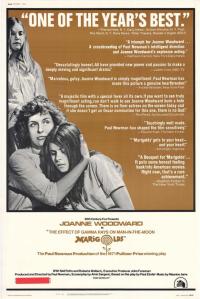
Paul Newman Behind The Camera: The Effect Of Gamma Rays On Man-In-The-Moon Marigolds (1972)

"I'm the original half-life, I got one daughter with half a mind, the other whose half a test tube, a house half full of rabbit crap and half a corpse! That's a half-life alright" - Beatrice Hunsdorfer


Paul Newman is arguably the greatest actor of his generation, with celebrated roles in such films as The Hustler, Butch Cassidy And The Sundance Kid, Cool Hand Luke and The Sting among many others. But sadly his work as a director is seldom discussed outside the most ardent cineaste circles.

His directorial debut; Rachel, Rachel (1968) was a hallucinatory spiral into the disconnected world of a middle-aged school teacher. Starring his wife, the superbly talented Joanne Woodward; with whom he shared fifty years of marriage. The legendary couple would co-star in ten films, with Newman directing four more starring Woodward.

Following a fine adaptation of Ken Kesey's Sometimes A Great Notion (1970) Newman's third directorial effort would be an adaptation of Paul Zindel's quizzically titled Pulitzer Prize-winning play; The Effect Of Gamma Rays On Man-In-The-Moon Marigolds. The play premiered in 1964, at the Alley Theatre in Houston, Texas. Before beginning an off-broadway run spanning 819 performances; from April 7th, 1970 through May 7th, 1972.


The story focuses on middle-aged Staten Island widow, Beatrice Hunsdorfer (Joanne Woodward) as she struggles to make a life for herself and her two daughters: rebellious epileptic Ruth (Roberta Wallach) and shy, introvert Matilda (Nell Potts). Despite her lower-middle-class existence, Beatrice still has some degree of vanity. In the films opening scene; Beatrice tries on wigs in a department store. Staring at herself in the mirror, it is quite obvious she does not like what she sees. Though she attempts to attract the romantic interest of her neighbor, only to brand him a "homo" when he declines her company.


The state of the Hunsdorfer home effectively sums up their lives. A house dilapidated enough to prompt Beatrice to label it "A pigsty". Her two daughters could not be more different from one another. Ruth, the eldest, suffers from epileptic seizures and is openly defiant of her mother, cruelly mocking her in front of her classmates by performing a skit in character as Beatrice. Rather ironic given that she is most likely to end up like her mother. Matilda, on the other hand, is almost a complete opposite. A quiet, shy and inhibited creature, interested in science and animals. Especially the rabbit she brings home from school. She attempts to explain her scientific interests to her mother and sister but is met only with incredulity and disinterest. Her science project serves as a metaphor for her personality and gives the film its name.

Beatrice dreams of opening an elegant tea room "A nice little neighborhood place" she intends to call "The Man-In-The-Moon Tea Shop". In the meantime, she rents out her spare room to elderly boarders. The latest of which is an ancient wheelchair-bound woman. As Beatrice matter of factly states; "If anybody had ever told me when I was younger I'd end up feeding honey to a zombie I'd have told em' they were crazy, I'd be better off driving a cab".  The presence of someone so frail and close to death is somewhat disturbing to Ruth, whilst relating her disgust of the situation to Matilda, she suffers a seizure.


Matilda's project earns her a place as a finalist in the school science fair. Which requires the attendance of her mother on stage in the auditorium. Beatrice promises to avoid embarrassing her daughter and say something simple if Matilda wins. Dressed in a garish fashion, Beatrice arrives late at the school, only to humiliate her daughter and make a fool of herself in front of the entire school, proclaiming "My heart is full" to the stunned reaction of the crowd. 

Upon returning home from winning first prize at the science fair, Matilda discovers that Beatrice has killed her pet rabbit. she cradles it in her arms as she carries it outside, laying it down in front of her mother. Matilda's internal monologue brings the film to a close, professing her love for science and her wonder of the universe and the atoms that hold it together. In a reply to Beatrice's earlier question as to whether she hates the world, Matilda solemnly states "No mama, I don't hate the world".


While also taking on the mantle of producer, Newman enlisted some notable heavyweights for this now almost forgotten drama. The screenplay was penned by the prolific Alvin Sargent; known for such thoughtful character pieces as Paper Moon and Ordinary People. Shot in somber tones by Adam Holender; who made his mark with the 1969 classic; Midnight Cowboy, as well as Al Pacino's starring debut; The Panic In Needle Park (1971). While Academy Award-winning composer Maurice Jarre; of Lawrence Of Arabia & Doctor Zhivago fame, would contribute the subdued musical score.


The film is anchored by the highly underrated Woodward's tour de force as Beatrice. A performance that would win the Georgia native her first and only best actress award at the Cannes film festival. The Newman's real-life daughter; Nell Potts, is surprisingly good as Matilda. The film's theater origins are clear, nonetheless, the staging is effective. Woodward's portrayal of a down-on-her-luck widow struggling to raise her two daughters ranks among her very best work. The story does at times draw parallels with a project later undertaken by the Newman's; the 1987 film adaptation of Tennessee William's The Glass Menagerie. In which Woodward again displays her talent for inhabiting complex and deeply troubled women.


Newman's direction is assured and purposeful. He directs as you imagine an actor would; searching for truth in the performances, rather than in visual flair or style. Newman's stature in the industry had the potential to launch him into a Clint Eastwood-like second career as a director. Yet I feel his project choices, while unique and interesting from a critical perspective, were somewhat limiting when considering box office appeal. Following Newman to the places he wanted to go as a filmmaker may have proved a bridge too far for a movie-going public otherwise entranced by his screen persona. 

Newman would direct five feature films and one TV movie; The Shadow Box (1980), also starring Woodward. He would serve as producer on several films, including one of his most famous; Butch Cassidy and The Sundance Kid (1969). His final credit as a producer would also prove to be his last on-screen role; portraying Max Roby in the 2005 HBO miniseries Empire Falls. 

Paul Newman died on September 26th, 2008, leaving behind an enviable body of work and portraying some of the most iconic characters in film history. His work behind the camera is interesting but not stellar, you may surprise many film fans by informing them that his directorial work even exists. You may also delight by introducing them to it, for if his presence as an actor was unique, I would argue his sensibilities as a filmmaker followed suit.


This piece was also published by Moviejawn


The Effect Of Gamma Rays on Man-In-The-Moon Marigolds (1972) will be released on Blu-Ray from Twilight Time on February 20th, 2018.